
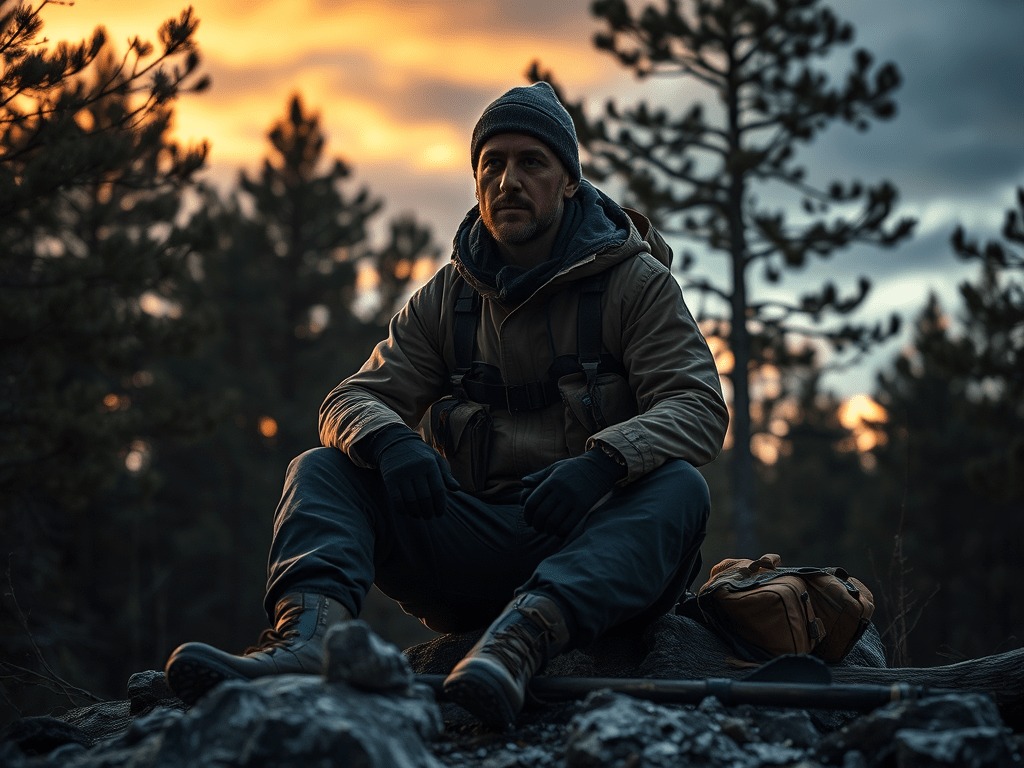
In June of 2015, a new survival show aired on The History Channel called Alone. The show aimed to showcase the survival skills of the contestants like the many survival themed shows that preceded it, but Alone , now in its 12th season, tested something new: the survival psychology of extreme isolation. This brought to light for many that survival doesn’t just depend on the hard skills and survival knowledge you have accumulated, nor does it rely solely on the tools and toys you have stockpiled to survive the zombie apocolypse. Your mental toughness and state of mind are at least as important as any of that stuff.
When facing the unforgiving conditions of the wilderness, your gear and skills are still essential, but it’s your mental toughness that determines whether you survive. A calm, focused mind can be the difference between making rational decisions and spiraling into panic. In this guide, we explore the mental challenges you may face in survival situations and how to develop the psychological strength needed to overcome them.
Understanding the Psychology of Survival
Mental strength in survival situations is just as critical as physical readiness. The psychology of survival focuses on how the human brain and emotions react under extreme stress, isolation, and danger. When the “fight, flight, or freeze” response kicks in, it can cloud judgment, narrow focus, and make even simple tasks difficult. Without proper mental preparation, fear can morph into panic, and discomfort can turn into despair. A mind stuck in the wrong survival state of mind can lead even the most talented bushcraft survivalist into making rookie mistakes.
Common emotional reactions in survival situations include:
- Panic from unfamiliar surroundings
- Despair due to uncertainty
- Overconfidence that leads to mistakes
Understanding these tendencies can help you counteract them before they take hold.
Mental Challenges You’ll Face in the Wilderness
Surviving in the wild is more than just lighting a fire or building a shelter. It means confronting mental challenges such as:
- Fear of the Unknown: Not knowing what’s coming next causes mental stress and impulsivity. This becomes especially problematic at night or in other situations with low visibility as your imagination can turn a harmless noise into wondering if a bear is about to rush you. A fear of the unknown in survival situations can lead to you expend unnecessary energy overbuildings shelters or staying awake all night.
- Isolation: Depending on the survival situation you may find yourself in, there is a fair chance you will have to face it alone until help arrives. Human beings are social creatures that require some kind of social interaction to maintain sanity. Prolonged loneliness can have a major impact on your mental and even physical wellbeing, with the American Psychology Association (APA) stating the effects of loneliness can cause depression, impair sleep, cause cardiovascular issues, and lower your immunity to diseases.
- Exhaustion: Survival situations will almost always require the expenditure of a great deal of physical and mental energies. Lack of quality sleep, whether from physical discomfort or mental issues, make the problem worse by preventing you from recharging. It does not take long for the fatigue of everything you must do to survive to build into exhaustion. Fatigue and exhaustion lead to poor decisions and decreased morale, which in turn leads to accidents and injuries.
- Discomfort: Pain and discomfort make you dread doing the things that are necessary for survival, such as building shelter or purifying water before drinking. Uncomfortable sleeping conditions can reduce the amount of quality sleep you are getting, increasing your levels of exhaustion. Small nuisances will build to day ruining events and send your mental state into a tailspin.
- Boredom: With little to do, time can seem endless, making mental endurance harder. Daytime can be busy and full of tasks to keep you in the right survival state of mind, but nightime and days with stormy or snowy weather can be dangerous to work so there is inevitably going to be time you can’t do anything. All this downtime allows your mind and imagination to work. Oftentimes, you will find yourself focusing on the tings you lack in these moments: food, comfort, modern conveniences, friends or family members, etc. Much like discomfort, this can send your mental state into a tailspin that is hard to crawl out of.
Knowing these challenges ahead of time allows you to prepare for them mentally, which is often more important than physical preparation.
Building Mental Resilience Before You Need It
Mental toughness can be trained just like your body. Here are a few practical ways to prepare before you ever find yourself in a survival scenario:
- Practice Positive Thinking: It sounds cliche, but having a positive outlook on things can help prevent negative emotions from settling in. People can’t control every thought that pops into their heads, but with practice, you can learn to throw away the negative thoughts and focus on the positive thoughts. Learning how to move on from disappointing situations and results and focusing on the next task is also essential for maintain a positive attitude. Positive thinking is a skill that must be learned and practiced, so start practicing now before you find yourself in a survival situation. Positive thinking is not just a light switch that can be turned on.
- Visualization: Mentally practicing what you should do in a stressful situation can make it easier for you to remember what to do in that situation. Mentally walk through tough survival scenarios in different environments and conditions and your response to those situations. Imagine what you would do in vivid detail, playing out your actions in your mind almost like a movie. Athletes do something similar where they run through plays or movements and call it mental reps. While this will never be as good as actual experience, it can be a good starting point of mental preparation.
- Discomfort Training: Intentionally exposinig yourself to situations that are uncomfortable will increase your tolerance to those discomforts in survival situation. Sleeping without your blanket or pillows, or sleeping on the floor, for example could make it easier for you to fall asleep if you got lost on a hike and had to spend the night in the woods. Skipping a couple of meals can help you get used to pushing through hunger. Be cautious with discomfort training, however. Always exercise good judgement and never put yourself into a dangerous situation. Never train yourself for hunger by completely starving yourself for an extended period of time. You are merely trying to get yourself used to some discomfort, not cause lasting damage to your body.
- Mindfulness and Journaling: These practices help build emotional regulation by healping you actively process the events of the day. Writing down the events of the day (or week if you prefer) brings those situations to the forefront of your mind, allowing you to consider how you feel about them and how you reacted to those situations. Over time this will gradually teach you how to recognize your own feelings and handle them in a positive, healthy manner. Much like maintaining a positive attitude requires time to learn and practice, mindfulness will also take time and practice so start now.
- Paractice Your Survival Skills: Confidence in yourself goes a long way towards overcoming fear, and confidence in a survival situation comes from knowing the survival challenge ahead of you is not too big. The only way to know you will be able to handle whatever is in front of you is to learn the necessary survival skills and practice them. And practice them extensively. You should know at least some of the basic skills well enough to perform them without much active thought.
Remember, the goal is not to completely eliminate fear or anxiety but to learn how to function alongside them or push through them. Courage is not the absence of fear, it is the making of action in spite of fear (M. Scott Peck).
Staying Calm Under Pressure: Survival Techniques for Crisis Moments
When you’re in the wild and something goes wrong, the worst thing you can do is panic. Here are field-tested strategies to stay calm and composed:
- STOP Technique: Stop, Think, Observe, Plan. This simple acronym can interrupt panic and create clarity. Acting irrationally based on emotion is a great way to make a bad situation worse. By forcing yourself to STOP, you give yourself a chance to assess the situation and, if needed, utilize other techniques for handling a survival crisis.
- Box Breathing: Box breathing is a technique for helping calm oneself down and manage stress. This technique can be used to calm yourself from an emotional moment, stop runaway negative thoughts, and even clear your mind while in pain. Inhale a deep breath slowly over a few seconds, hold that breath for a few seconds, exhale slowly for a few second, and hold without inhaling again for a few seconds. Repeat until you feel more in control.
- Micro-goals: How do you eat an elephant? One bite at a time. Break down big problems into smaller tasks. Need to start a fire? Gather tinder, then tinder and fuel, then build the fire. Need to build a shelter? Gather some poles, then build your frame, then fill in the frame, and, if needed, then add insulation. By breaking bigger tasks into smaller ones, you can more efficiently organize your work, make the problem seem smaller, and give yourself a sense of accomplishment and mental boost each time you complete one of these micro-goals.
How Mental Toughness Affects Group Survival
When people rely on each other, the psychological strength of the group becomes more important than the skills of any one individual within the group. Humans are naturally wired to seek out groups for safety, and a group allows for the work of survival to be spread out amongst all the members. Despite these obvious advantages, however, there are also drawbacks that can rear their ugly heads.
If you’re not alone in a survival situation, your mental state doesn’t just affect you, it affects everyone. Believe it or not, but emotions are actually contagious. If you are irritable or otherwise in a negative mood, this negativity can and likely will spread to others in your group. Likewise, a negative attitude from someone else in your group can drag down your emotional state. The good news is that positive emotions can spread as well. So if you maintain a positive attitude it can help to lift everyone’s spirits and increase everyone’s chances of survival.
Group leaders in survival situations are rarely the smartest or most talented individuals. Leaders in survival situations are the ones that have hardwired their survival psychology to maintain a positive attitude and lift up the morale of the entire group, inspiring the people around them to not give up hope. Not everyone has what it takes to be this type of leader, but at the very least you should actively be trying not to be the one that drags the group morale down.
Conflict management is essential in a group survival situation. Tension will be high and everyone will be afraid, and this can lead to divides within a group. Knowing how to defuse a situation and talk through differences of opinion is the best way to make sure everyone makes it home safely.
The Psychology of Surviving Alone
Solo survival brings unique mental challenges. Without companionship, there’s no external moral support, accountability, or feedback. The isolation can magnify stress and lead to emotional instability.
Key psychological factors include:
- Self-talk: There is nobody else around who can help lift your emotional state or motivate you. Your inner dialogue becomes your main source of support. Positive self-talk will boost your morale.
- Time Distortion: Without social interaction or structure, time can feel endless and disorienting. The days will feel long and the nights even longer. Keep your mind active, either with tasks or entertainment to mitigate this time distortion.
- Depersonalization: Extended isolation can lead to detachment from reality.
To prepare for solo survival, practice spending time alone in nature, learn to enjoy your own company, and develop routines to create structure in unstructured environments.
Conclusion: Prepare Your Mind Like You Prepare Your Gear
In survival situations, mental toughness isn’t a luxury—it’s a necessity. You can have all the right gear, knowledge, and experience, but if your mind fails, the rest crumbles with it. Training your mindset before you need it is one of the most important survival tools you can develop.
When it comes to survival, don’t just pack your knife—pack your mindset.
 Rugged Edge
Leave a comment